Surveillance and gossip
The House of Bernarda AlbaSurveillance and gossip in The House of Bernarda Alba are not background details but a social system: the prospect of being watched, overheard, and discussed constrains the women inside Bernarda Alba’s house, while reports from outside bring the village’s judgments into it. Bernarda tries to manage that scrutiny through commands and secrecy, yet her household’s tensions keep producing evidence that cannot be controlled. The result is a pointed contrast between what the family knows and what it is willing to let the village hear.
A household organized around the listening neighbour
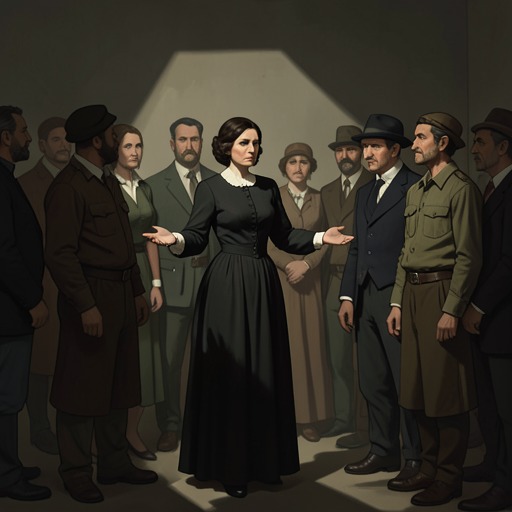
Bernarda’s attention repeatedly turns from what is happening inside her house to how it might appear beyond its walls. When noise breaks out over Angustias’s missing portrait of Pepe el Romano, she interrupts the dispute to warn that the neighbours will have their ears pressed to the walls. Her response makes the threat of overhearing part of the conflict itself: the daughters are not only arguing with one another, but are being told to imagine an audience just outside the house.
That imagined audience helps explain Bernarda’s insistence on command and concealment. She tells Angustias that she has no right except to obey, rejects the idea that anyone can dictate what happens in her home, and orders the matter kept quiet when Poncia suggests that Pepe was at one of the windows at around four in the morning. Bernarda frames possible accusations as a wave of filth sent by other people to drown the family. The image presents gossip as an external attack, even as her determination to suppress it makes the household’s silence increasingly tense.
Rumour, reputation, and uneven power
The commentary on the play places Bernarda’s concern within a culture in which family honour depends heavily on public perception. Sexual conduct can become the subject of gossip and damage a family name; that pressure helps account for Bernarda’s scrutiny of her daughters and her preoccupation with what neighbours might hear. Her concern is not limited to sexual reputation: she criticizes the Servant over the house’s cleanliness before the mourners arrive and objects to the daughters’ quarrels because neighbours may hear them. Keeping up appearances extends from domestic order to family conduct.
The same commentary emphasizes that this concern is shared across the household and village, though not always with the same authority. Poncia, despite her different position from Bernarda, says that she wants to live in a respectable house and avoid disgrace in old age. Prudencia’s account of her husband’s quarrel with his brothers over an inheritance shows how a family dispute becomes common gossip and a source of damaged reputation and distress. The play thus presents surveillance as a community practice: talk carries private conflicts outward, and the knowledge that talk travels encourages people to regulate themselves before anyone openly intervenes.
Yet the rules governing reputation are unequal. The commentary describes a male-dominated society in which women’s sexual conduct could threaten the family name, while men enjoyed greater freedom. Poncia’s account of men moving on from the marriage bed to the table and then the tavern places that imbalance within ordinary married life. Bernarda’s authority over her household therefore does not undo the wider gender order; she enforces its demands upon her daughters and joins a system that grants men more latitude.
Private knowledge and public alarm
The dispute over Angustias’s engagement shows how money, kinship, and gossip intersect. Her sisters point out that she is the only rich daughter because her father’s money sets her apart, and they question why Pepe el Romano would court her rather than younger sisters they consider more attractive. Their remarks reveal resentment around both the inheritance and the marriage. Bernarda’s later attack on Angustias for wearing powder on the day of her father’s funeral follows the revelation that her husband, Antonio María Benavides, left Angustias much more money than his four natural daughters. The commentary raises, without resolving, the possibility that this unequal bequest reflects a closer relationship between him and his stepdaughter, and asks whether Bernarda suspects it. It stresses that the household’s silence conceals secrets rather than proving their absence.
At the point when the village’s attention becomes visible, the Servant reports a crowd at the top of the street and neighbours standing at their doors. Bernarda sends Poncia to find out what is happening, then rebukes the daughters for going to the windows and orders them into the courtyard. The women listen to distant sounds without daring to approach the exit. Surveillance here is no longer only imagined: the assembled neighbours and the sounds beyond the house make the village’s judgment an immediate presence, while the mourning rules still govern who may approach the door.
Poncia explains the cause of the commotion: Librada’s unmarried daughter has had a child, killed it, and concealed it under stones; dogs have uncovered the child and left it at her doorstep. The men are pursuing her, and Bernarda explicitly urges them to come with olive switches and pick-handles and kill her. Adela protests against killing the woman, while Martirio says they should go out too. The episode shows how a sexual and family secret, once exposed, becomes a public accusation and a threat of collective violence. Bernarda’s support for the crowd makes her concern for honour more than a wish to avoid embarrassment: she endorses the community’s punishment of a woman whose conduct has become visible.
Secrecy as control and tragic ending
Even when Bernarda claims to be defending the household from false accusations, the play gives reason to question her confidence. Poncia warns that Pepe was at a window in the early morning but admits that nothing is known for certain. Bernarda rejects the warning as a reason to yield control, vows to find out for herself, and insists that the matter remain quiet. Later, when Poncia says she has covered up more than Bernarda knows, Bernarda asks whether Poncia’s son still sees Pepe at four in the morning. Poncia answers that they say nothing. Knowledge and silence are therefore distributed through the house: servants and daughters may know or suspect what Bernarda does not, while choosing not to state it openly.
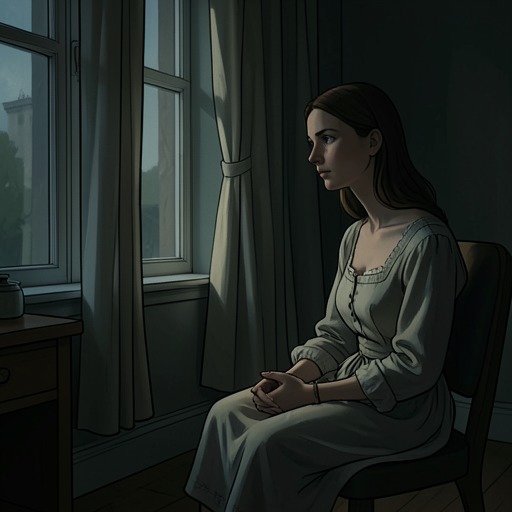
Poncia describes the cost of that arrangement as a silence containing a storm in every room. She says she has tried to head things off but is now frightened too, while the Servant says Bernarda’s pride blinds her to the power men have over lonely women. Poncia adds that Pepe is not solely to blame and invokes the gendered maxim, “A man is a man.” The exchange connects household secrecy with the unequal sexual rules that make women’s reputations especially vulnerable and leave Bernarda’s command unable to resolve the conflict it conceals.
After Adela’s death, Bernarda’s response completes the pattern. She declares that Pepe has escaped, orders that Adela be cut down and dressed as a virgin, and insists that no one will say anything. She tells the family that her daughter died a virgin, forbids weeping, and repeats her command for silence. The claim is a deliberate management of public knowledge, not a resolution of the truth: the family is ordered to preserve an appearance that conceals the circumstances of Adela’s death. The final silence thus exposes the limits of Bernarda’s rule. She can dictate what her household is to say, but the effort to control reputation has not prevented the secrets, conflicts, and consequences that made such control necessary.
The commentary also notes that the Spanish Penal Code of 1870 allowed a husband to cleanse his honour with blood in specified cases involving adultery or rape, and that this provision was not abolished until 1963. It cautions that the precise legal situation does not occur in the play, while observing that Bernarda shares the fanatical mentality behind such honour-based thinking. The distinction matters: the village’s pursuit of an unmarried mother and Bernarda’s final cover-up are presented as social and familial actions, not as direct enactments of that law. Together, they show how gossip and reputation can authorize pressure and punishment without being identical to formal justice.